Does behaviour fall into discrete states?
Not yet. One method found none and could not find one we planted; MoSeq finds regimes but cannot carve them the same way twice.
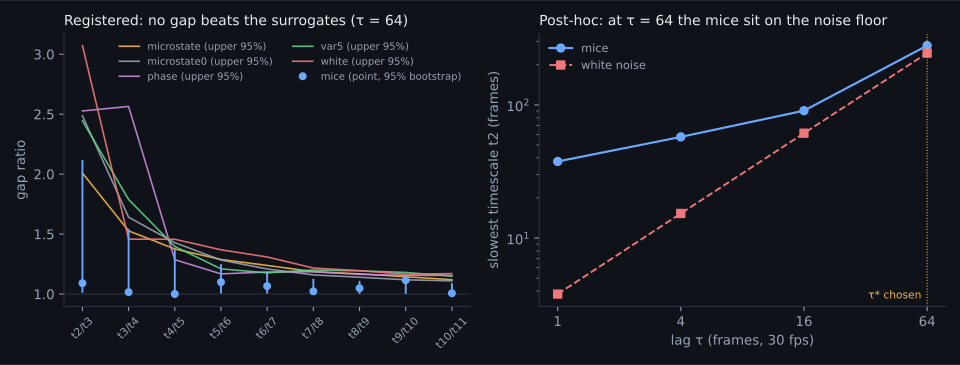
This is not evidence that behaviour is a continuum. A 2 s switch planted at +1 SD in two channels was recovered at chance, at every lag tried. The null comes from an instrument that failed its own sensitivity check.
| step | what the registration said | what happened |
|---|---|---|
| memory K | shortest window within 1% of the best 0.5 s forecast | 1 frame: past frames add nothing |
| lag τ | where the slowest timescale stops growing | never stops; fell to the grid edge, 64 frames |
| gate 1 | a gap beats all five surrogates | none does |
| gate 2 | states reproduce across splits and seeds | not reached |
| gate 3 | the planted switch is recovered | 0.500: fail |
Why it failed. The lag rule waited for a plateau, but the noise floor grows with the lag, so it ran to the grid edge, where the floor hides everything. At short lags the mice have many slow directions of about equal speed (eigenvalues 0.973, 0.964, 0.962) and no gap, so there are no few dominant states to pick out, planted or real.
What the transfer operator splits, at a lag of one frame
Not registered, and not states. At a one-frame lag, where the mice beat white noise, the largest spectral gap gives two macrostates. Each holds 7–11% of frames; the other 82% abstain. Four clips each, green border inside.
state 1 · 11.4% of frames · median bout 1.0 s
state 0 · 6.5% of frames · median bout 1.0 s
MoSeq, run as a test
MoSeq always returns syllables: its prior assumes discrete regimes. So it was run with the answer fixed in advance, on the repaired pose before smoothing, beside white-noise and phase-randomised copies fitted the same way.
| check | mice | phase-randomised | white noise | bar | verdict |
|---|---|---|---|---|---|
| gain over one linear AR (nats/frame) | 5.32 | 2.69 | 1.63 | mice beat both by 0.05 | pass: +2.63 [2.37, 2.91] |
| syllables agree across seeds (median AMI) | 0.473 | 0.556 | 0.641 | ≥ 0.70 | fail |
| syllables in use | 13–16 | 27–31 | 24–30 | reported | — |
| median dwell (frames) | 18–19 | 39–43 | 21–25 | reported | — |
Verdict: fail. The mice carry structure a switching model captures and noise does not. But the syllables that carve it change with the random seed, agreeing less than white noise's do. White noise also gets more syllables than the mice.
What the syllables look like
Four report animals per syllable, 2 s each, starting half a second before the bout. A green border marks the frames MoSeq put in the syllable. These are for looking: the syllables failed the seed test, so none is a behaviour.
syllable 0 · 47.7% of frames · median bout 1.9 s
syllable 1 · 11.9% of frames · median bout 1.1 s
syllable 2 · 9.4% of frames · median bout 1.2 s
syllable 3 · 5.4% of frames · median bout 1.1 s
syllable 5 · 4.0% of frames · median bout 1.2 s
syllable 25 · 3.3% of frames · median bout 2.8 s
syllable 4 · 2.7% of frames · median bout 0.8 s
syllable 7 · 2.2% of frames · median bout 1.0 s
syllable 10 · 2.1% of frames · median bout 1.2 s
syllable 8 · 1.7% of frames · median bout 0.8 s
syllable 12 · 1.6% of frames · median bout 1.3 s
syllable 9 · 1.3% of frames · median bout 0.8 s
syllable 30 · 1.2% of frames · median bout 8.5 s
syllable 6 · 1.0% of frames · median bout 0.7 s
syllable 16 · 0.9% of frames · median bout 0.7 s
| decoding arena A vs B | balanced accuracy |
|---|---|
| freezing alone | 0.669 [0.634, 0.703] |
| syllables, moving frames | 0.749 [0.717, 0.779] |
| both | 0.765 [0.734, 0.797] |
| syllables, freezing frames only (leak check) | 0.710 [0.677, 0.744] |
Syllables add to freezing, but they read the arena too: they decode it on freezing frames, where behaviour should not differ. The registered reading is confounded, and descriptive only since MoSeq failed. The freeze threshold scores 64% of frames as freezing, so that check is weaker than intended.
The pose it ran on
| pose | skull jitter (/bl) | bone violations | fast motion kept | moved (px) |
|---|---|---|---|---|
| raw DLC | 0.0351 | 1.78% | 100% | 0 |
| disposition | 0.0335 | 1.42% | 90% | 0.05 |
| repaired (adopted) | 0.0289 | 1.44% | 31% | 1.14 |
The repair passes all four gates. Skull jitter falls 18% against raw DLC, violations stay at the cleaned level, and it keeps more fast motion than the old shipped pose (22%). Almost all of the gain is the 0.25 s median filter.
SAM's mask vetoed only 0.07% of keypoints, 72% of them the nose, and 3.2× as often in arena B as in A. At one keypoint in a thousand it cannot drive a result, but its cause is not settled.