Can the crop be lined up without keypoints?
On a still animal, yes. On a moving one, not well enough.
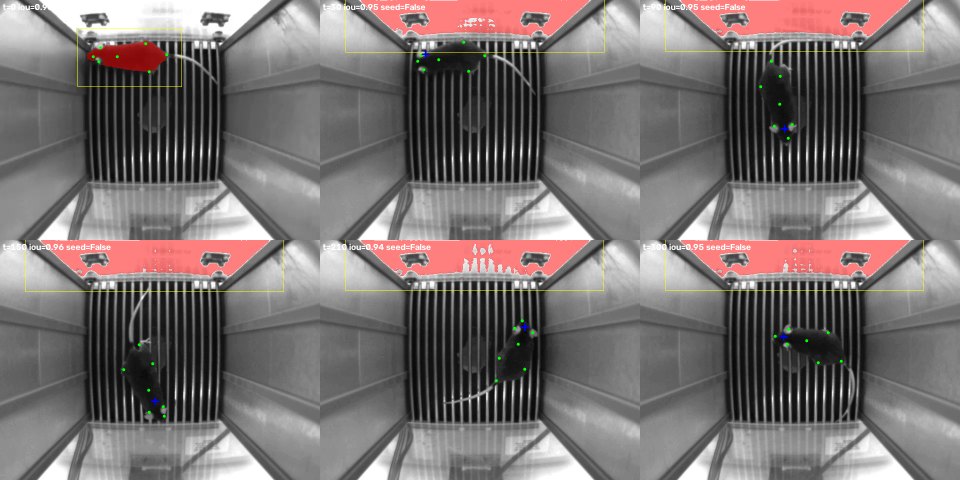
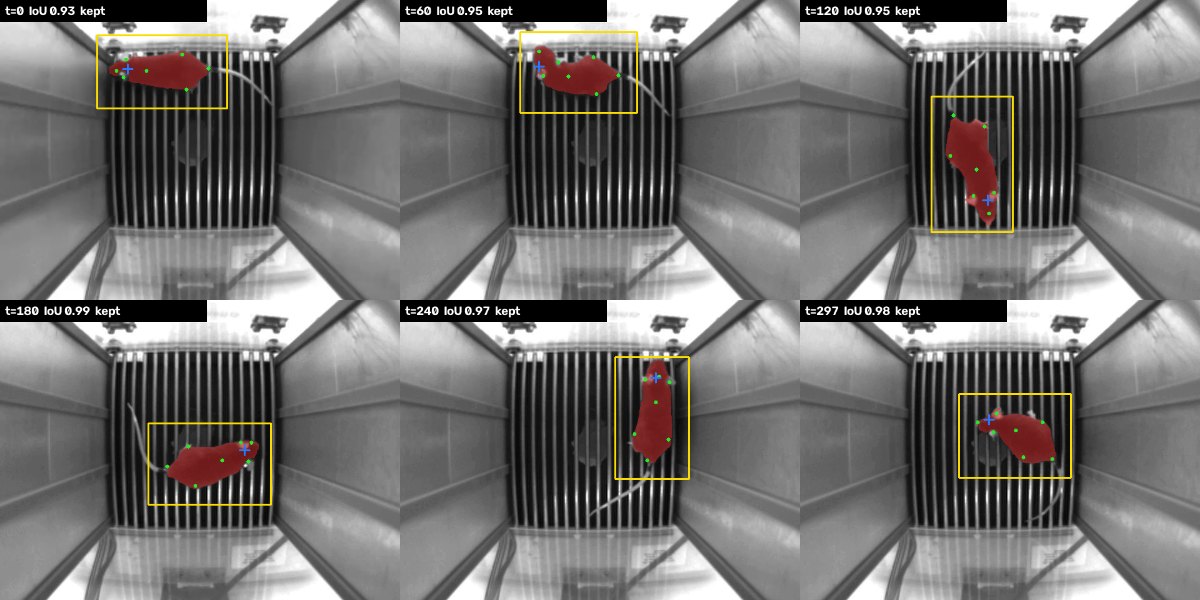
| alignment | 0 on animal | 1 duplicates | 2 jitter | 3 still frames | 4 moving plant | arm |
|---|---|---|---|---|---|---|
| 1 · median-background mask | — | PASS | NOT_A_RESULT | NOT_A_RESULT | FAIL [1134.851, 2474.794] | NOT_A_RESULT |
| 1 · phase correlation on that mask | — | PASS | NOT_A_RESULT | NOT_A_RESULT | FAIL [619.103, 1559.352] | NOT_A_RESULT |
| 2 · keypoint-masked background | — | PASS | NOT_A_RESULT | NOT_A_RESULT | NOT_A_RESULT | NOT_A_RESULT |
| 2 · ECC on that mask | — | PASS | NOT_A_RESULT | NOT_A_RESULT | NOT_A_RESULT | NOT_A_RESULT |
| 3 · SAM, moment warp | FAIL [0.585, 0.750] | FAIL | FAIL [0.039, 0.148] | NOT_A_RESULT | FAIL [14.994, 19.947] | NOT_A_RESULT |
| 3 · SAM, ECC | FAIL [0.585, 0.750] | PASS | FAIL [0.208, 0.299] | NOT_A_RESULT | FAIL [13.551, 19.453] | NOT_A_RESULT |
| 4 · SAM from the located animal, ECC | PASS [0.923, 0.950] | PASS | PASS [0.999, 1.000] | PASS [1.016, 1.063] | FAIL [15.343, 18.736] | FAIL |
| 5 · ECC on the animal only | PASS [0.923, 0.950] | FAIL | PASS [1.000, 1.002] | FAIL [1.854, 2.779] | FAIL [1.266, 1.344] | FAIL |
| 6 · same, from the better of two starts | PASS [0.923, 0.950] | PASS | PASS [1.000, 1.002] | FAIL [1.844, 2.773] | FAIL [1.266, 1.344] | FAIL |
| 7 · stage 6, scored on the animal's own pixels | PASS [0.923, 0.950] | PASS | PASS [0.999, 1.000] | PASS [1.003, 1.060] | FAIL [1.934, 2.346] | FAIL |
| incumbent, animal pixels | PASS [0.905, 0.933] | FAIL | NOT_A_RESULT [7.709, 12.266] | FAIL [1.373, 2.171] | FAIL [6.435, 10.323] | FAIL |
| real fast frames, 10-frame chains | 6 · body motion vs keypoints |
|---|---|
| 4’s unmasked ECC, re-run | FAIL [0.520, 0.611] |
| 5 · ECC on the animal only | PASS [1.073, 1.095] |
| 6 · from the better of two starts | PASS [1.056, 1.078] |
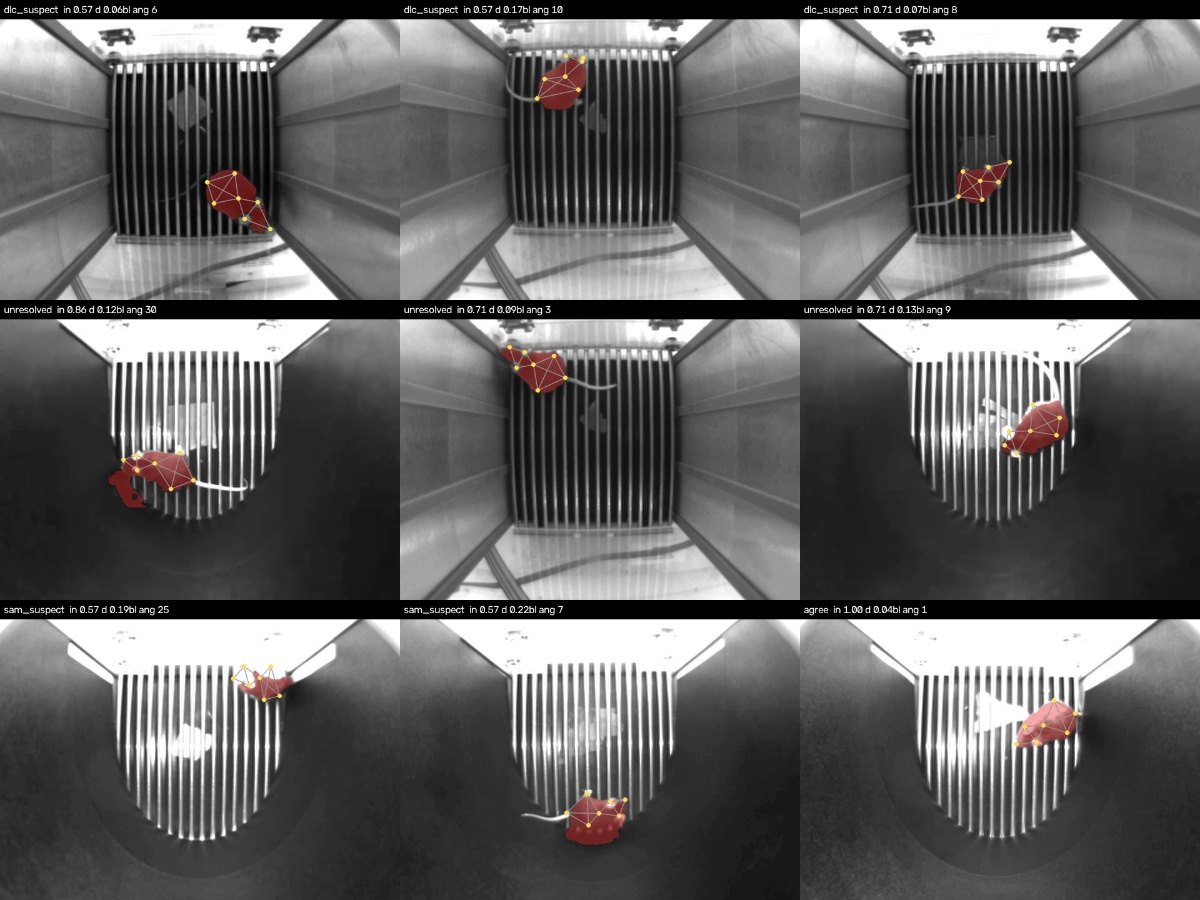
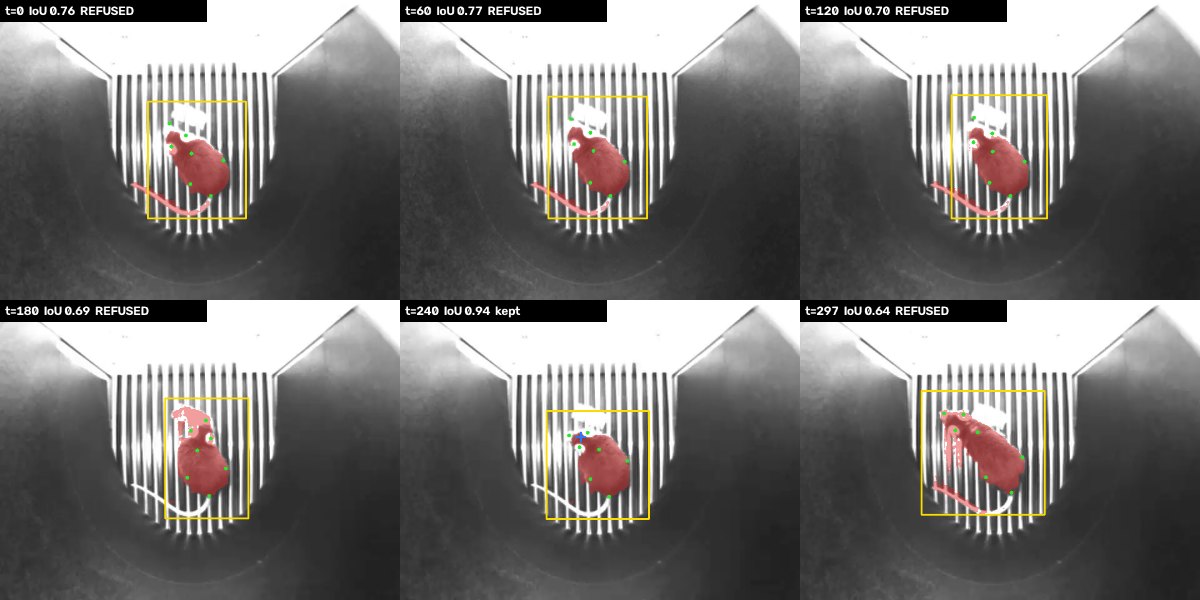
Ten full recordings, both detectors on. Red fill is SAM's mask as the pipeline used it; amber is the DLC skeleton. The mask's outline shows whether the two agree (green), disagree (amber, magenta, orange) or SAM was refused, and a red dot marks any keypoint outside the mask.
Watch it
210 s · refused 0.8% of frames · head disc on the mask 78% of keyframes
180 s · refused 94.8% of frames · head disc on the mask 92% of keyframes
210 s · refused 0.1% of frames · head disc on the mask 92% of keyframes
180 s · refused 2.1% of frames · head disc on the mask 64% of keyframes
210 s · refused 0.0% of frames · head disc on the mask 99% of keyframes
180 s · refused 12.6% of frames · head disc on the mask 90% of keyframes
210 s · refused 0.2% of frames · head disc on the mask 97% of keyframes
180 s · refused 0.1% of frames · head disc on the mask 96% of keyframes
210 s · refused 0.7% of frames · head disc on the mask 81% of keyframes
180 s · refused 1.1% of frames · head disc on the mask 99% of keyframes
Two detectors, two checks
| keypoint | outside SAM's mask, all keyframes | on keyframes where they disagree |
|---|---|---|
| right ear | 16.0% | 64.0% |
| nose | 13.8% | 61.0% |
| left ear | 13.0% | 54.3% |
| tail base | 5.8% | 19.9% |
| right hip | 3.3% | 17.6% |
| left hip | 2.4% | 13.0% |
| body centre | 0.5% | 3.4% |
Mask and keypoints agree on 81% of frames. When they do not, the usual cause is SAM cutting off the head: the nose and ears fall outside the mask on about one frame in seven, the body centre almost never. The head is what a grooming measure needs, so the next step is to prompt SAM with the nose and ears as points.
| ears outside the mask | context A | context B |
|---|---|---|
| box prompt (current) | 10.0% | 20.1% |
| box + keypoints as points | 5.4% | 9.0%, mask balloons onto the wall |
| guarded: points only near the mask, area capped | 5.9% | 15.8% |
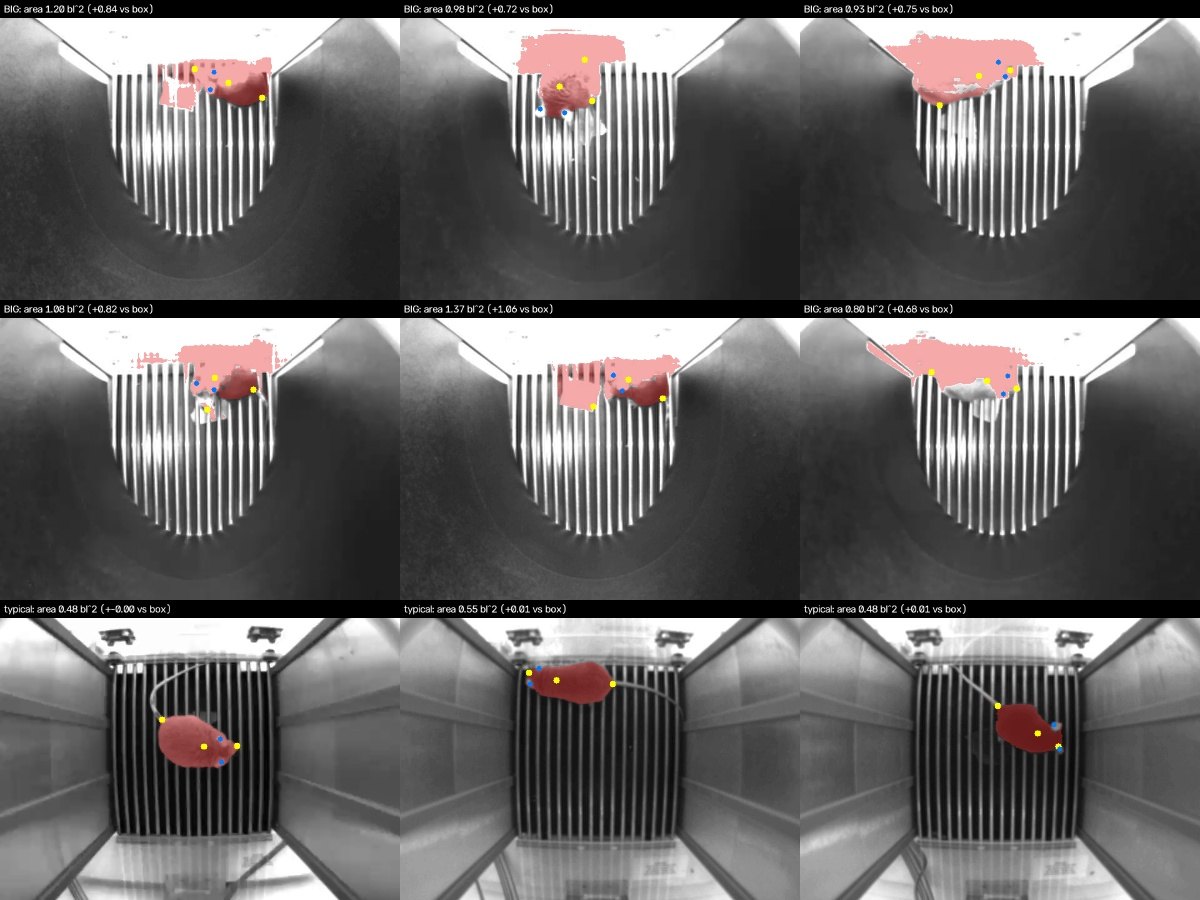
Giving SAM the nose, centre and tail as points brings the head back, measured on the ears it was never given. But where DLC puts a keypoint on the bright wall, SAM follows it there. Guarded, each detector checks the other first: the head returns in context A with no ballooning, much less so in B.
Head coverage depends on the arena. Even the plain box mask clips the head twice as often in context B. Any A-versus-B comparison of a head-region measure has to control for how much head each frame's mask contains.
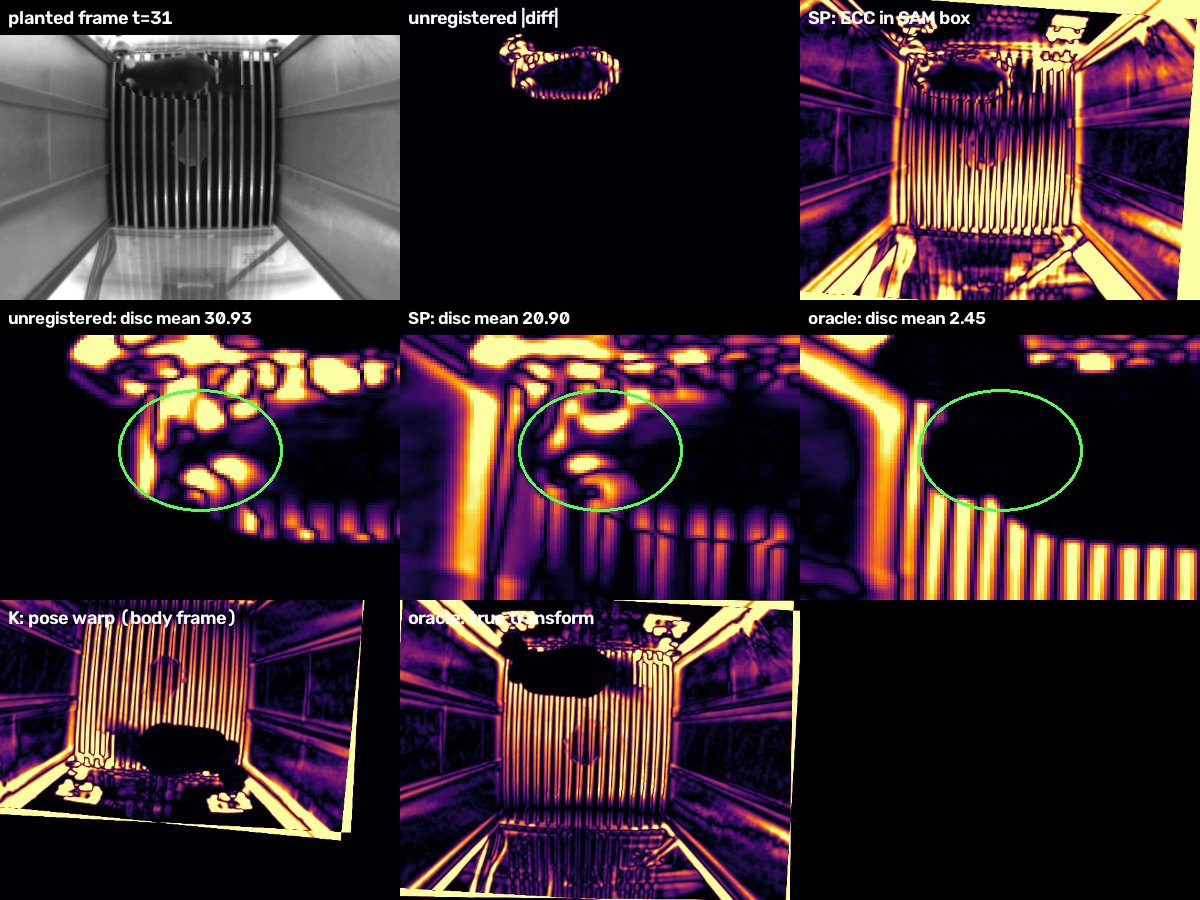
Stage 4 passes every still-frame gate. It is exact on byte-identical frames, within a few percent of perfect on truly still ones, and planted keypoint jitter does not reach it. The incumbent reports motion on every duplicate frame.
Stage 5 follows moving animals. Restricting the alignment to the mouse's own mask brings the moving plant within about 30% of a perfect alignment, where stage 4 was 17 times off. On real video its body motion agrees with the keypoints (column 6). But it fails the still-frame gates stage 4 passed, so each arm solves the case the other fails.
Stage 7 ends the line. Scored on the mouse's own pixels, the stage-6 alignment passes every still-frame test, within 3% of perfect, and follows the body on real video. It fails only the moving-head test: about twice a perfect alignment, where perfect keypoints manage 1.4. A stop rule set before the run ends the search there.
Stage 6 starts the masked fit from no motion and keeps whichever start fits better. That made it exact on identical frames. It still fails the still-frame gate, and the likely reason is the gate: its disc reaches the bar floor, which the fit's sub-pixel animal motion moves. The next test scores the animal's own pixels.
Stage 4 fails on moving animals. Inside SAM's box the static bar floor pulls the alignment toward zero while the mouse pulls it toward its motion, and the fit settles in between at every speed. An earlier write-up said it locked onto the floor; the pictures above corrected that.
Column 6 is the keypoints used as a referee, on the fastest quarter of real frames: they are too noisy for fine head motion but sound for where the body went. Chained over ten frames, the masked fits agree with them to within about 3–8% either way; the unmasked fit recovers at most about half of the body's motion.
Some FAILs above carry no information. Stage 1's gate 4 could not be passed by any alignment, even a perfect one (DEVIATIONS D23), and stage 2's gates 3 and 4 were ill-posed (D24). The jitter gate of stages 1–3 rested on a doubtful premise (D25), which is why stage 4 plants the jitter instead.
Each defect is recorded rather than fixed after the fact. Every cell opens its record. Nothing on this page is read as grooming.