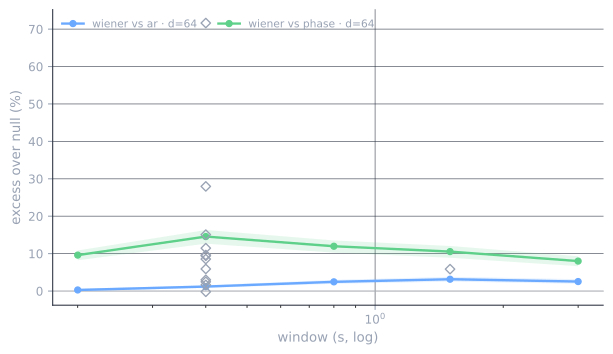
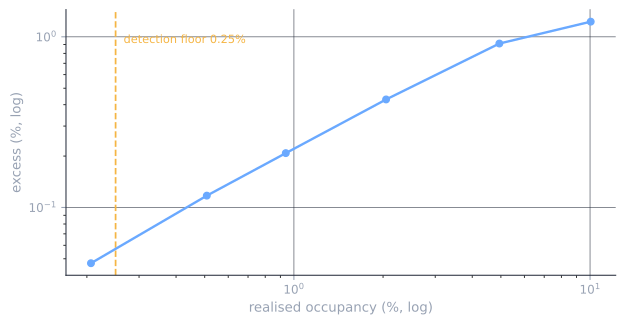
How much more a stretch of movement recurs across animals than a fitted null predicts, at each window length tried. The colored lines are the corpus scored against two null models (a fitted linear process, and a phase-randomized version of the real data); the gray diamonds are single-point sanity checks — noise against noise, and a smooth random process against its own null — sitting at zero.The same excess, now against how much artificial repeated motif was planted into the data. This calibrates the y-axis: it is what turns “excess” into a real quantity, and lets the occupancy-equivalent and detection-floor numbers below be read as shares of frames rather than abstract percentages.
+1.639%[+1.205%, +2.080%]
excess over a vector-AR null
how much more often a stretch of one animal's movement has a near-match in another than a fitted linear model predicts. w = 0.4 s, full dimension, on the Wiener-filtered arm; animal bootstrap over 89 animals
10.9%[7.7%, 14.2%]
occupancy-equivalent
read through the dose curve: this share of all frames is behaving like a shared, repeated motif
0.05%
detection floor
the smallest true effect this method could still tell apart from nothing
-0.199%[-0.464%, +0.042%]
the same corpus, unfiltered
the identical window and dimension without the filter — opposite sign, and an interval that spans zero. This is why the arm is named on every recurrence number above
Recurrence: a stretch of movement in one animal having a near-copy in another. Measured with no labeller, no clustering and no assumption that behaviour comes in discrete types — just a search for close matches across animals, scored against models built to look similar without actually repeating.
No labeller is involved in this measurement, which is why it has survived every retraction on this site. It is measured on the filtered arm; unfiltered, the same cell finds nothing.
Every recurrence number on this page is the Wiener-filtered arm at w = 0.4 s. The identical cell computed without the filter is the fourth stat above: opposite sign, interval spanning zero. Which arm a number was computed on is part of the number, and the work that follows on Models runs on the unfiltered array — so it does not read itself against this one.
Five clustering arms across two representations, scored on the same corpus, land from 0.090 to 0.778 on the same composite. Nothing in that family adjudicates the others, which is why this page doesn't add a sixth — the full ranking is on Results.